One of the ways of navigating blindfold through the streets of Antibes is by sense of smell. There are the acrid, gagging smells of the piss-soaked winos who sleep rough near the back entrance to the Parking de la Poste. Then there are the not unpleasant fishy wafts from the stands where the local fishermen sell their catch.
There are the strong rising currents of aromatic fermentation from the sewers, now beginning to heat up nicely. Then there are are the sudden reminders of restaurants, via their backstreet kitchen air extractors.
What beats the acidic smell of dogshit from the flowerbeds, a defecatory abundance which makes the job of town gardeners so repulsive here, is the heady perfume of the many orange and lemon trees. The flowers don't look very spectacular, but they give off an indecent amount of fragrance, as if somebody had gone wild with all the samples in an airport duty free shop. It's a good time to be in Antibes.
mardi 27 avril 2010

lundi 26 avril 2010
Lord of the rings
I have begun to realise that I am repeating myself. Well, not in the sense of going gaga, but rather in the sense of doing things or seeing things again.
Today, on the way to the Post Office, passing Mamo's newly done-up eatery, I thought I recognised somebody, vaguely Algerian or Gypsy by the dress code. Then she stooped, with considerable balletic abilities for somebody with embonpoint, and picked up a ring from the street, wondering out aloud: "De l'or, de l'or". I recognised the voice immediately: it was the same female con-artist who worked the Antibes street last year.
She hadn't recognised me, but I had surely recognised her.
dimanche 25 avril 2010
Bain de mer
First it was cold and then it was hot. Not a puerile inversion of James Joyce but rather a truthful description of the initial freeze followed by burning sensation caused by my first sea swim of the year. The air was balmy, the sea was a beautiful blue, and everything conspired to invite me into the water.
Especially other bathers who 'tested the waters' only to renounce baptism. I just had to prove that I was made of sterner stuff. So, after a brief scan of the waters to determine the jellyfish quotient (none visible), I did a shallow dive in, swam about thirty metres out, did a brief lateral swim, then headed for the shore. By that time, sensations were a thing of the past and it was time to get out before losing muscle power.
Still, it felt good to have started the season so early: last year was a lot later (see my blog of 29th May 2009).
To the scaffold


The old town is full of buildings needing TLC. It is a constant race between three factors: the surprisingly damp conditions of the Mediterranean coast, the justified but still annoying attentions of the Architectes de France who decide things when it comes to listed structures, and the needs of the town to make tourist money during the season.
All this means that there is a small window of opportunity when builders have sufficiently good weather and municipal approval to put up scaffolding and carry out repairs. We are now into that season, and one of the properties sheathed in metal and nylon netting is our own.
Tempesta e bonaccia
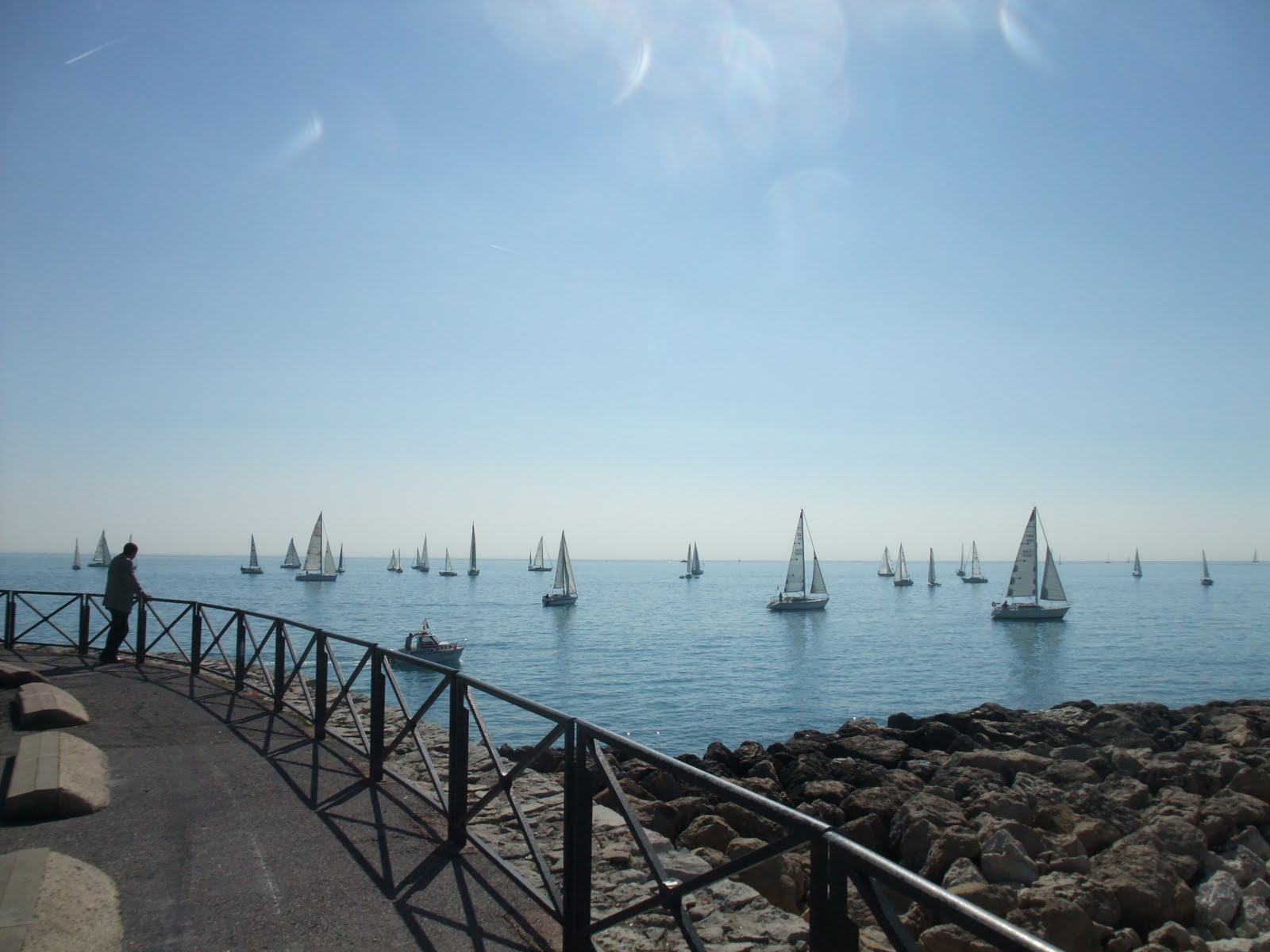

The other day the wind was whistling through the thrashing palm fronds and whipping up a frightening sea. Today, however, the organisers of a regatta managed to create a record turnout, but failed to put on any wind.
jeudi 22 avril 2010
Mosquito coast
There are various traditional signs that spring is with us: snowdrops, daffodils, first calls of the cuckoo. Here, it is the first mosquito bite during the night. I woke up this morning with my right eye unopenable. A mozzie had paid attention to the blood supply in my eyelid.
Aiming with my one remaining opening eye, I sent a stream of lethal flyspray into the bedroom, closed the door, and hoped that insect carnage had begun.
Aiming with my one remaining opening eye, I sent a stream of lethal flyspray into the bedroom, closed the door, and hoped that insect carnage had begun.
mardi 20 avril 2010
Deepest Africa
It must be a particular privilege of countries which have shrunk, especially those with past imperial pretensions, to have more stuff on display than they can presently afford. Britain's museums are an example, now holding on to former booty by claiming conservation standards and responsible stewardship, but not so long ago displaying looted treasures proudly as trophies of divinely-willed expansion and projection of power.
Another example is Belgium, whose colonial escapades under the aegis of Leopold II in the Congo aroused such international indignation. Leopold bequeathed his grateful nation a gargantuan Central African Museum, deep in the tropical rainforest of the Brussels periphery, at Tervuren. We decided to take a look.
To get there, like the trip up country in Conrad's The Heart of Darkness, required stamina and intrepid organisation. It was a journey beyond human experience. We took a bus, a tram, an underground train, and finally a country tram which rattled through the endless woodlands to the south of Brussels. Finally, we reached a clearing with a strange semi-circular wooden edifice, where the tram stopped and the driver left us. Was it a temple to some bloody ancestor cult? What nameless horrors had it witnessed after sundown as the waning moon bathed its decaying timbers in an eerie light? In fact it was Tervuren Terminus, standing forlorn in the middle of nowhere, with trees on every side.
We found a rusty iron gate, yawning half open, held up by decaying pillars covered in sprayed graffiti suggesting genito-oral pleasures, and, taking a deep breath, headed into the domain of darkness. After following a range of signs which looked as though they had been dumped there rather than deliberately planted for giving directions, we re-emerged into the sunlight to find a grandiose palace, with magnificent lawns, ornamental fountains and lakes, dubious statues and the usual Belgian smell of waffles frying. It was the museum.
Inside, the marbled entrance hall was crowded with immense gilded statues of European gods and goddesses acting as tutelaries to adoring midget Africans invariably sculpted as children. This was clearly not a PC building. But once through the entrance, the anthropological and historical displays were both spectacular and intellectually challenging. And the best thing was that the colonial experience was pretty honestly depicted, with starring roles for Arab slave traders, Belgian entrepreneurs, a rogue Welshman (the Denbigh-born Henry Morton Stanley of 'Dr Livingston, I presume' fame) and the rapacious ogre himself, Leopold II. There were some gruesome exhibits, particularly the meticulous paperwork (Belgium and bureaucracy start with the same letter) which recorded the attempts to get the reluctant locals to tap rubber, including the report of one colonial administrator justifying the expenditure of over 2,000 rounds of ammunition, on the grounds that his policemen had after all killed over a thousand men, women and children, and that the survivors were now busy tapping rubber as they should.
So it was, after all, a journey to a dark land of savages, but the savages were us, not them. We came away with a fresh white man's burden, a sense of shame.
Inscription à :
Articles (Atom)